Every fall, thousands of executive teams file into a conference room, order too much coffee, and spend two days doing what they call "strategic planning." Here's the uncomfortable truth: most of them aren't actually doing strategic planning.
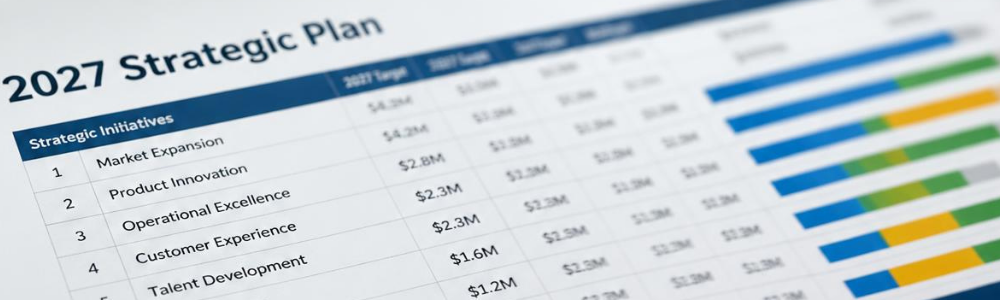
Often, what's happening in that room is a budget exercise wearing a strategy costume. Each business line presents what they did last year and what they think they can deliver next year. The numbers get debated, massaged, and eventually aligned. Everyone shakes hands, feels good about the plan, and walks out with a spreadsheet.
There's nothing wrong with that exercise. Every company needs a disciplined budgeting process and a solid operating plan. But that spreadsheet is not a strategy. It's a forecast of your existing operations, with the expectation that you'll run them a little better next year than you did this year.
Back in 1996, Michael Porter wrote what's still one of the most important business articles ever published: What Is Strategy? His core argument was simple and still gets ignored constantly: operational effectiveness is not strategy. Doing what you already do, but better, faster, or cheaper, is table stakes. It may keep you competitive for a while, but it won't take you somewhere fundamentally new.
Strategy, Porter argued, is about making a distinct set of choices. It's deciding what not to do as much as what to do. It's a deliberate set of trade-offs, not a rolled-up P&L.
Most planning processes never get there. They stay focused on what each division can deliver, then call the sum of those numbers "the plan." What they've really produced is an operating plan supported by a budget.
Here's the analogy I come back to constantly. If you're sitting in Boston and decide you want to take a trip, you don't say, "I want to go on a 3,000-mile drive." Nobody plans a trip by counting miles. You decide you want to drive to San Diego.
Once you've picked the destination, an entirely different set of questions comes into focus. Which route makes the most sense? Do you go through Chicago or Dallas? Are there places you want to see along the way? What terrain or conditions aren't you prepared for today that you'll need to figure out before you leave?
The destination tells you where you're trying to go. The route determines how you'll get there. The obstacles along the way tell you what you'll need to be prepared for before you arrive.
Strategy works the same way. The budget may tell you how many miles you expect to cover this year, but strategy determines where you're headed, the path you'll take to get there, and what capabilities you'll need to build along the way.
In our work with CEOs, we push hard against the traditional planning model, the one where the room exists to align on a number and each business unit gets a slot to present its case for next year's budget.
Instead, we treat strategic planning as a small set of decisions made by the CEO and executive team about the path to the destination. The conversation centers on the two or three capability gaps standing between where the company is today and where it's trying to go.
That means asking harder questions than, "What can we deliver next year?" Questions like:
Notice what's missing from that list: the budget number. The budget is a downstream artifact of the strategy. It's how you allocate resources behind the path you've chosen and was never supposed to be the plan itself.
If your strategic planning process produces a stack of division-by-division numbers that roll up into next year's budget, you've built a very useful budget, not a strategy.
A real strategic plan names the destination, then commits the organization to building those capabilities ahead of everything else that's simply operational improvement.
This year, challenge yourself to rise above the operational and create a real strategy that, when executed, gets the business closer and closer to your desired destination.





.png)

