Most CEOs have sat through a strategic planning offsite that felt productive in the room but changed very little once everyone got back to the office. The conversations were good, the whiteboards filled up, and a month later the business was running the same way it had before. In my experience, much of that comes down to the team not being clear that the offsite is just one important milestone in a longer race.
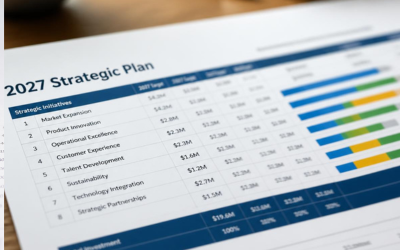
In Strategic Ascent, the offsite has a very specific role within a larger process. That process starts with individual preparation, where the CEO puts a point of view on paper in the CEO Presentation and each member of the leadership team completes written pre-work, including a SWOT analysis and their own thinking on what the goals for the business should be. Then comes the offsite, when the team comes together, ideally for two days in a place that is not the office. The goal is to do the hard thinking as a group, building on the work already done, through a process that drives deep collaboration and lands the team in strong alignment around two to four strategic goals, along with how each goal will be measured and the targets that will tell you whether you are succeeding.
How Alignment Gets Built
Alignment builds in rounds. The CEO’s point of view gives the team something concrete to push against, a stake in the sand that can be moved. Leaders question whether those are the right goals, propose different ones, and argue over what belongs inside each goal and what does not. A Focus Area gets added, another gets dropped, and the wording changes as people find better ways to say what they mean. I think of it as a team working on a painting together, deciding what goes in the picture and what stays out, and understanding from each other’s perspective why each choice was made. By the end, the goals belong to the whole team rather than to the CEO alone.
Choosing What You Will Not Do
When a team picks its two to four strategic goals, it is also choosing, by default, everything that will not be pursued, and making those choices together as a group is part of the work. No one enjoys making those calls, but every company, regardless of size, has limited resources, and everyone in the room has a day job on top of whatever change the plan asks for. When a team walks out with a long list of goals, it has usually avoided the hard calls, stretched its resources too thin, and left without real clarity on what matters most, and a year later, it has little meaningful progress to show on any of them.
Everyone Needs a Voice
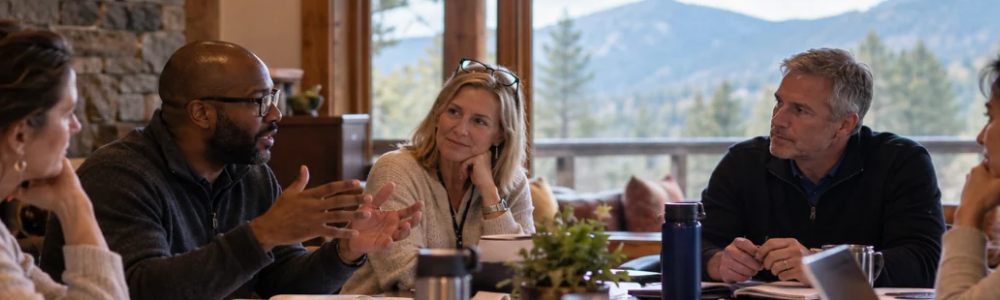
Real alignment depends on everyone in the room having a voice and ample opportunity to debate and challenge the potential goals. In any group of eight (the top of our recommended range, some people will talk more and some will talk less. We address this by using small groups. Cutting the group in half doubles each person’s chance to speak at any given moment and gives the quieter members of the team room to share what they are thinking. It also brings dissenting views into the open early, and more often than you might expect, a point of view that started with one or two people in a small group becomes the one the full team chooses once everyone comes back together.
People who never get the chance to make their case rarely buy in fully, and even if the final answer lands exactly where the CEO started, there will not be alignment unless the group had the opportunity to get to a place of shared ownership.
Written Down and Clear
By the end of the offsite, the goals and their measures should be written down. They do not have to be perfect, but they do have to be clear. The wording matters, because everyone on the team needs to be able to own these goals and there can’t be confusion afterward about what was meant, so the time spent wordsmithing in the room is part of getting to that clarity.
Some targets may still need refining after the offsite, and that is fine. We are setting the team up for execution rather than 100 percent accuracy, and the more important outcome is that the team leaves ready to move into action planning and start making progress.
Why It Has to Be Off-Site
We ask clients to hold the offsite away from the office, ideally with an overnight in between, and to keep laptops closed and phones put away. Taking your executive team out of the business for two days is a real investment of their time, and that time needs total focus. In a conference room down the hall, people step back to their desks at lunch or get pulled into whatever came up that morning, moving in and out of business as usual all day. You have to guard that time, and getting the team out of the building takes them out of the day-to-day grind and the mindset that comes with it.
A change of scenery, including an overnight, helps them step into a different headspace and means they will not be looking at their watch to do soccer pick up.
Where Strategic Planning Breaks Down
The offsite is an important part of a longer process. It is the forum where the team comes together to get clear on what the focus should be, and it will determine the success of what happens in the months that follow. Even with a strong accountability system, which Strategic Ascent provides, a plan will stall if the team lacks clarity and alignment around the goals and true ownership from every leader needed to move them forward. That is the point where strategic planning most often fails, and it is a big part of why so many CEOs believe in strategic planning but don’t feel good about the outcome.